SUUNTO SS020420000 Tandem Compass Clinometer 360PC/360R
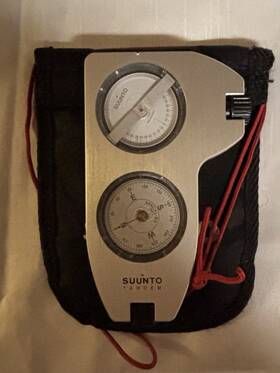
( Brand: Suunto ), ( Manufacturer Part Number: SS020420000 ), ( Model: 360PC/360R ), ( Country Of Origin: Finland ), ( Product: Surveying )
Review SUUNTO Tandem Professional Compass And Clinometer Model 360pc/360r
The **Suunto SS020420000 Tandem Compass Clinometer 360PC/360R** is a rugged, precision-engineered navigation tool designed for outdoor enthusiasts, surveyors, and professionals who demand reliability in demanding environments. This classic Suunto instrument combines a **magnetic compass** with a **clinometer**, offering unparalleled versatility for measuring angles, slopes, and elevations with accuracy. The **360-degree rotating bezel** ensures seamless navigation, allowing users to align bearings effortlessly, while the **clinometer scale** marked in degrees from 0 to 90 enables precise incline measurements, making it indispensable for hiking, caving, or technical climbing. Crafted from durable **anodized aluminum**, the compass is built to withstand harsh conditions, including moisture, dust, and temperature fluctuations, ensuring long-term performance in the field. The **liquid-filled housing** dampens vibrations, providing stable readings even in motion, while the **luminous markings** and **illuminated dials** enhance visibility in low-light conditions, such as early morning or evening expeditions. Whether used for **topographic surveys, route planning, or emergency navigation**, this tool delivers the precision and durability expected from Suunto s legendary design. Its **compact yet sturdy construction** makes it easy to carry in a pocket or attach to gear, ensuring it s always within reach when critical decisions depend on accurate orientation and slope assessment. Ideal for both recreational adventurers and seasoned professionals, the **Suunto SS020420000 Tandem Compass Clinometer** remains a timeless accessory for those who prioritize reliability and performance in the great outdoors.
The Suunto SS020420000 (Tandem Compass Clinometer 360PC/360R) is a classic, durable, and versatile tool designed primarily for surveying, navigation, and outdoor activities like hiking, mountaineering, and military use. Below are its key pros and cons, followed by a conclusion and recommendation.
---
### **Pros**
1. **Durability and Build Quality**
The Suunto Tandem is renowned for its rugged construction, often made from aircraft-grade aluminum or steel. It is designed to withstand harsh conditions, including extreme temperatures, moisture, and rough handling. This makes it ideal for fieldwork, military use, or outdoor adventures where reliability is critical.
2. **Versatility of Functions**
The device combines multiple tools in one:- **Compass**: Accurate for navigation, including declination adjustment.
- **Clinometer**: Measures angles (e.g., slope gradients, tree heights, or elevation changes) with a 360-degree protractor for precise readings.
- **Protractor**: Useful for surveying, construction, or technical tasks requiring angle measurements.
- **Level Vials**: Helps with leveling instruments or checking horizontal alignment.
- **Ruler**: A linear scale (typically in centimeters and inches) for measuring small distances or objects.
- **Magnifying Lens**: Useful for reading small details or maps.
The 360PC (Protractor Clinometer) and 360R (Reflector Clinometer) variants offer slightly different features (e.g., the 360R includes a reflective surface for easier reading in bright light), but both are highly functional.
3. **Precision and Accuracy**
The compass is calibrated for magnetic navigation, and the clinometer provides readings with a degree of precision suitable for most field applications. While not as advanced as digital tools, it offers reliability in environments where electronics may fail (e.g., extreme cold, water, or electromagnetic interference).
4. **No Power Required**
Unlike electronic devices, the Tandem operates mechanically, eliminating the need for batteries or charging. This makes it low-maintenance and dependable in remote or off-grid locations.
5. **Classic Design and Ergonomics**
The compact, lightweight design (typically weighing around 100 150 grams) makes it easy to carry in a pocket or attach to a lanyard. Its simple, analog interface is intuitive and requires minimal training to use effectively.
6. **Long Lifespan**
With proper care, a Suunto Tandem can last decades. Many units are passed down through generations or used by professionals for years without significant wear.
7. **Compatibility with Other Tools**
The Tandem can be paired with other surveying instruments (e.g., alidades, levels) or used as a standalone tool. Its design aligns with traditional surveying practices, making it a staple in fields like forestry, geology, and civil engineering.
8. **Resale Value**
Due to its durability and reputation, a well-maintained Suunto Tandem holds value in the used market. It is often sought after by collectors or professionals replacing older models.
---
### **Cons**
1. **Limited Digital Features**
The Tandem lacks modern conveniences like GPS, digital storage, or connectivity. Users must manually record data, which can be error-prone and time-consuming. For tasks requiring data logging or analysis, a digital device may be more efficient.
2. **Subject to Human Error**
Accuracy depends entirely on the user s ability to read the dials and interpret the compass. Factors like fatigue, poor lighting, or inexperience can lead to inaccuracies. Digital tools often provide automatic corrections or readings.
3. **No Built-in Adjustments for Local Conditions**
While the compass can be adjusted for declination, it cannot account for local magnetic anomalies or variations in altitude that might affect readings. Digital compasses can sometimes compensate for these factors with software adjustments.
4. **Maintenance Requirements**
Although low-maintenance, the Tandem requires occasional cleaning to prevent dust or moisture from affecting the moving parts (e.g., the clinometer s pivot or the compass needle). Rust can develop if not stored properly, especially in humid environments.
5. **Learning Curve for Advanced Use**
While basic navigation is straightforward, mastering all functions (e.g., precise clinometer readings for surveying) may require practice. New users might find it less intuitive than a digital tool with guided instructions.
6. **Limited Range of Measurements**
The clinometer s precision is limited by the physical scale (typically to the nearest degree or half-degree). For highly technical applications (e.g., engineering surveys), a digital inclinometer or theodolite may offer finer resolution.
7. **Not Waterproof in All Variants**
While many Suunto tools are water-resistant, the Tandem s sealing can degrade over time. It is not designed for submersion or high-pressure water exposure. Users should avoid prolonged exposure to moisture.
8. **Replacement Parts Can Be Difficult to Find**
As Suunto has shifted focus to digital products, replacement parts (e.g., compass needles, clinometer pivots) may become harder to source. Users should keep spare parts or consider alternatives if the tool is critical for their work.
9. **Outdated for Some Modern Applications**
In fields where digital data collection is standard (e.g., environmental monitoring, construction with CAD integration), the Tandem s analog nature can be a drawback. It may require additional steps to transfer data to digital formats.
10. **Cost Relative to Digital Alternatives**
While the Tandem is affordable for a high-quality analog tool, digital compasses or clinometers with similar functions (e.g., digital inclinometers) may offer more features for a comparable price. However, the Tandem s longevity often justifies its cost for many users.
---
### **Conclusion**
The Suunto SS020420000 Tandem Compass Clinometer is a **highly reliable, durable, and versatile analog tool** that excels in environments where simplicity, mechanical robustness, and offline functionality are prioritized. It is an excellent choice for:
- Outdoor enthusiasts (hikers, mountaineers, survivalists) who value self-sufficiency and low-tech navigation.
- Surveyors, foresters, or engineers working in remote areas where digital tools are impractical or unavailable.
- Military personnel, cadets, or scouts who require a no-frills, low-maintenance instrument for training or field exercises.
- Collectors or professionals who appreciate the craftsmanship and legacy of analog tools.
However, it is **not ideal** for users who:- Require digital data logging, GPS integration, or advanced calculations.
- Need high-precision measurements for technical applications (e.g., civil engineering surveys).
- Prefer the convenience of automatic adjustments or error correction provided by digital devices.
- Operate in environments where water exposure or extreme conditions are frequent (unless properly maintained).
The Tandem strikes a balance between tradition and utility, making it a **practical investment for those who prioritize durability and simplicity over digital sophistication**.
---
### **Recommendation**
**Buy the Suunto Tandem if:**- You need a **long-lasting, no-battery-required tool** for navigation, surveying, or outdoor activities.
- You work in **off-grid or high-stress environments** where electronic tools might fail.
- You appreciate **mechanical precision** and are willing to invest time in learning its functions.
- You value **portability and ruggedness** over digital features.
**Consider alternatives if:**- You require **digital data collection, GPS, or advanced surveying functions** (e.g., digital clinometers like the Suunto Core or Trimble tools).
- You need **higher precision** for technical work (e.g., digital inclinometers or theodolites).
- You frequently work in **wet or corrosive environments** and need a fully waterproof device (some Suunto digital tools offer this).
**Final Verdict:**For its intended purposes, the Suunto Tandem is a **superior analog tool** that remains relevant despite the rise of digital technology. It is particularly well-suited to those who seek reliability, simplicity, and a connection to traditional fieldwork methods. If you can overlook its lack of digital features, it is a worthwhile purchase for decades of use.
Details:
part #: ss020420000 prices
- $139.99-$296.00
specifications totalstationsurveyzo:
- brand: Suunto
- mpn: Ss020420000
- model: 360pc/360r
- country of origin: Finland
- product: Surveying
offer totalstationsurveyzo:
- started: May 7, 2026
- sold: 0
- options: Ship-to-home
- quantity: 1
- availability: In Stock
- best offers: True
general totalstationsurveyzo:
- Test, Measurement Inspection > Levels Surveying Equipment > Total Stations Accessories
- condition: Used
seller totalstationsurveyzo:
- rating: 100.0%
- city: North Canton, Ohio
- # reviews: 373
returns totalstationsurveyzo:
- policy: No Returns
payments totalstationsurveyzo:
- credit card: Mastercard
- other
- wallet: Google-pay
shipping totalstationsurveyzo:
- type: Calculated
- transit: 5-12 Days
- service: USPS Ground Advantage
- class: Standard
- cost: $9.35
- carrier: USPS