ZEISS 5000-2207 Cirrus Angio
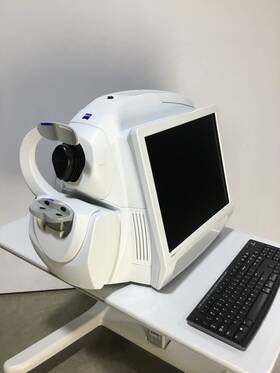
( Brand: Zeiss ), ( Manufacturer Part Number: 5000-2207 ), ( Unit Type: Unit ), ( Product: Laser Scanner, Ophthalmic ), ( Country Of Origin: Germany )
Review ZEISS Cirrus 5000 Non angio Excellent Condition
The **Zeiss Cirrus 5000 (Model 5000-2207)** is a high-performance, non-angio optical coherence tomography (OCT) scanner designed to deliver unparalleled clarity and precision in retinal imaging for clinical and research applications. Engineered by Carl Zeiss Meditec, a leader in ophthalmic diagnostics, this advanced device combines cutting-edge technology with intuitive workflows to provide clinicians with detailed, high-resolution cross-sectional images of the retina. The Cirrus 5000 excels in capturing fine structural details, including the retinal nerve fiber layer (RNFL), ganglion cell complex (GCC), and macula, with exceptional speed and consistency, making it an indispensable tool for diagnosing and monitoring glaucoma, macular degeneration, diabetic retinopathy, and other retinal pathologies. Its proprietary **Spectralis** technology, though not directly referenced in the model number, influences its performance, ensuring minimal motion artifacts and high signal-to-noise ratios through adaptive optics and enhanced scanning protocols. The Cirrus 5000-2207 features a **2207** scan pattern, which includes a comprehensive set of built-in protocols such as the **Macula Cube 200x200**, **Optic Disc Cube 200x200**, and **RNFL Analysis**, allowing for thorough volumetric imaging and quantitative analysis of retinal layers. Its **non-angio** designation indicates that this specific model does not include the advanced vascular imaging capabilities of the AngioPlex module, focusing instead on structural OCT analysis. The device integrates seamlessly with Zeiss s **iVue** imaging software, offering automated segmentation, advanced analytics, and a user-friendly interface that streamlines diagnostic workflows. With its **10-micron axial resolution** and **680 nm superluminescent diode (SLD) light source**, the Cirrus 5000 ensures sharp, detailed images that facilitate early detection of retinal changes, enabling clinicians to make informed decisions with confidence. Whether used in a busy ophthalmology practice or a specialized research setting, the Zeiss Cirrus 5000-2207 stands as a reliable and sophisticated instrument for advancing retinal diagnostics.
The Zeiss Cirrus 5000 (model number 5000-2207) is a high-end optical coherence tomography (OCT) system designed for ophthalmic imaging, particularly for retinal and anterior segment scans. Below is a detailed breakdown of its pros and cons, followed by a conclusion and recommendation.
---
### **Pros of the Zeiss Cirrus 5000 (Non-Angio)**
1. **High-Resolution Imaging**
The Cirrus 5000 uses advanced OCT technology to provide detailed cross-sectional images of the retina and anterior segment. Its high resolution (5 m axial resolution) allows for precise visualization of retinal layers, making it useful for diagnosing and monitoring conditions like glaucoma, macular degeneration, and diabetic retinopathy.
2. **Comprehensive Imaging Modes**
The system offers multiple scan protocols tailored to different clinical needs:- **Macular Cube 200x200**: Ideal for assessing macular health.
- **Optic Disc Cube 512x128**: Useful for glaucoma evaluation.
- **Anterior Segment Imaging**: Captures detailed images of the cornea, anterior chamber, and iris, expanding its utility beyond retinal imaging.
- **Segmentation Capabilities**: Automated segmentation of retinal layers (e.g., RNFL, GCC) simplifies quantitative analysis and reduces operator dependency.
3. **Fast Scan Speeds**
The Cirrus 5000 delivers rapid imaging speeds, reducing patient discomfort and improving workflow efficiency. This is particularly beneficial in clinical settings where multiple scans are required.
4. **User-Friendly Interface**
The system is designed with an intuitive interface, making it accessible for both experienced ophthalmologists and less experienced technicians. The automated alignment and scan protocols minimize the learning curve.
5. **Non-Angiography Advantage**
The non-angiography version (5000-2207) avoids the complexity and cost of OCT angiography (OCTA), which may not be necessary for all clinical applications. This makes it a more straightforward and cost-effective option for practices that do not require vascular imaging.
6. **Integration with Clinical Workflows**
The Cirrus 5000 can be integrated with electronic health records (EHR) and other imaging systems, facilitating seamless data sharing and longitudinal patient monitoring.
7. **Durability and Reliability**
Zeiss is known for building robust medical imaging equipment. The Cirrus 5000 is designed for long-term use in clinical settings, with minimal downtime and reliable performance.
8. **Research and Diagnostic Versatility**
The detailed imaging provided by the Cirrus 5000 is valuable for both clinical diagnosis and research. Its ability to capture high-resolution scans makes it a tool for studying retinal pathologies in depth.
---
### **Cons of the Zeiss Cirrus 5000 (Non-Angio)**
1. **High Initial Cost**
The Cirrus 5000 is a premium device, and its upfront cost can be prohibitive for smaller clinics or private practices. The price includes not only the hardware but also software, maintenance contracts, and potential training costs.
2. **Maintenance and Service Costs**
Like all high-end medical equipment, the Cirrus 5000 requires regular maintenance and calibration. Zeiss s service contracts can be expensive, and unplanned repairs may incur additional costs.
3. **Space Requirements**
The system requires dedicated space in the clinic or hospital, which may not be available in smaller or busier facilities. Proper installation, including environmental controls (temperature, humidity), is essential for optimal performance.
4. **Learning Curve for Advanced Features**
While the interface is user-friendly, mastering advanced features such as segmentation analysis and interpreting detailed retinal scans may require training. Staff must be adequately trained to avoid misdiagnosis or errors.
5. **Limited Angiography Capability**
The non-angiography version lacks OCTA, which is increasingly valuable for diagnosing conditions like diabetic macular edema, age-related macular degeneration (AMD), and retinal vascular diseases. Practices focusing on these areas may find the Cirrus 5000 less versatile.
6. **Software Dependencies**
The Cirrus 5000 relies on proprietary software for analysis and reporting. Compatibility issues or software updates may occasionally disrupt workflows, and reliance on a single vendor can be a limitation.
7. **Patient Comfort and Cooperation**
OCT imaging requires patients to remain still for several seconds to minutes, which can be challenging for uncooperative patients (e.g., children or anxious adults). This may affect scan quality or require additional staff support.
8. **Depreciation Over Time**
Medical imaging technology evolves rapidly. While the Cirrus 5000 is a high-quality device, newer models with improved features (e.g., AI-assisted analysis, higher resolution) may render it less competitive over time.
9. **Data Storage and Security**
The system generates large volumes of imaging data, which must be securely stored and managed. Ensuring compliance with healthcare data regulations (e.g., HIPAA) adds an administrative burden.
10. **Competition from Other Systems**
Other OCT manufacturers (e.g., Heidelberg Engineering s Spectralis, Topcon s DRI OCT, or Canon s 3D OCT) offer alternatives with varying features, prices, and strengths. Practices must compare these options to ensure the Cirrus 5000 is the best fit.
---
### **Conclusion**
The Zeiss Cirrus 5000 (5000-2207) is a powerful and versatile OCT system that excels in providing high-resolution retinal and anterior segment imaging. Its strengths lie in its detailed imaging capabilities, user-friendly design, and comprehensive scan protocols, making it ideal for clinics focusing on glaucoma, macular diseases, and anterior segment evaluations. However, its high cost, maintenance requirements, and lack of angiography may limit its appeal to practices with specific needs or budget constraints.
For practices that prioritize detailed retinal imaging without the need for OCT angiography, the Cirrus 5000 is a robust and reliable choice. It is particularly well-suited for:
- Specialized ophthalmology clinics (e.g., glaucoma, retinal disease centers).
- Academic or research settings where high-resolution imaging is critical.
- Facilities with the budget and infrastructure to support premium medical equipment.
---
### **Recommendation**
**Buy the Zeiss Cirrus 5000 (5000-2207) if:**1. Your practice specializes in retinal or anterior segment imaging where high-resolution OCT is essential.
2. You do not require OCT angiography and prefer a simpler, non-angiography system.
3. You have the budget to cover the initial purchase, maintenance, and potential training costs.
4. Your facility has the space and technical support to integrate the system smoothly into your workflow.
5. You value Zeiss s reputation for reliability and durability in medical imaging.
**Consider alternatives if:**1. Your practice frequently diagnoses vascular-related retinal diseases (e.g., AMD, diabetic retinopathy), in which case an OCTA-enabled system (e.g., Cirrus HD-OCT with AngioPlex) may be more valuable.
2. You are operating on a tight budget, as lower-cost OCT systems (e.g., Topcon 3D OCT-1) may offer comparable features at a reduced price.
3. Your clinic lacks the space or technical support to maintain high-end equipment effectively.
**Final Suggestion:** Before purchasing, conduct a thorough cost-benefit analysis, including:- Direct costs (purchase price, software, installation).
- Indirect costs (maintenance, training, staff time).
- Long-term value (how the system will impact patient care, diagnostic accuracy, and practice revenue).
Additionally, request demos or trials if possible to ensure the Cirrus 5000 aligns with your clinical needs. Consulting with peers or colleagues who use the system can also provide valuable insights.
Details:
ZEISS CIRRUS 5000 Non-Angio - Fully operational Licensed software Clean unit well maintained.
part #: 50002207 price
- $20000.00
specifications totalstationsurveyzo:
- brand: Zeiss
- mpn: 5000-2207
- unit type: Unit
- product: Laser Scanner, Ophthalmic
- country of origin: Germany
offer totalstationsurveyzo:
- best offers: True
- started: May 8, 2026
- options: Ship-to-home
- sold: 0
- quantity: 1
- availability: In Stock
shipping totalstationsurveyzo:
- class: Standard
- service: USPS Ground Advantage
- cost: $0.00
- carrier: USPS
- type: Calculated
- transit: 5-11 Days
general totalstationsurveyzo:
- condition: Used
- Test, Measurement Inspection > Levels Surveying Equipment > Total Stations Accessories
seller totalstationsurveyzo:
- rating: 100.0%
- # reviews: 2
- city: Sharjah, UAE
returns totalstationsurveyzo:
- policy: No Returns
payments totalstationsurveyzo:
- wire transfer
- credit card: Mastercard
- wallet: Apple-pay
- other
Zeiss 5000-2207 Is Similar To:
- Zeiss 33186 Carl Ni 2 Automatic Survey Level Made In Germany Great Condition (44.1% similar) Carl Zeiss ni 2 automatic survey level made in germany great condition, see pictures for condition...(May 4th, 2026)